The Kazinga Channel: Africa’s Great Boat Safari
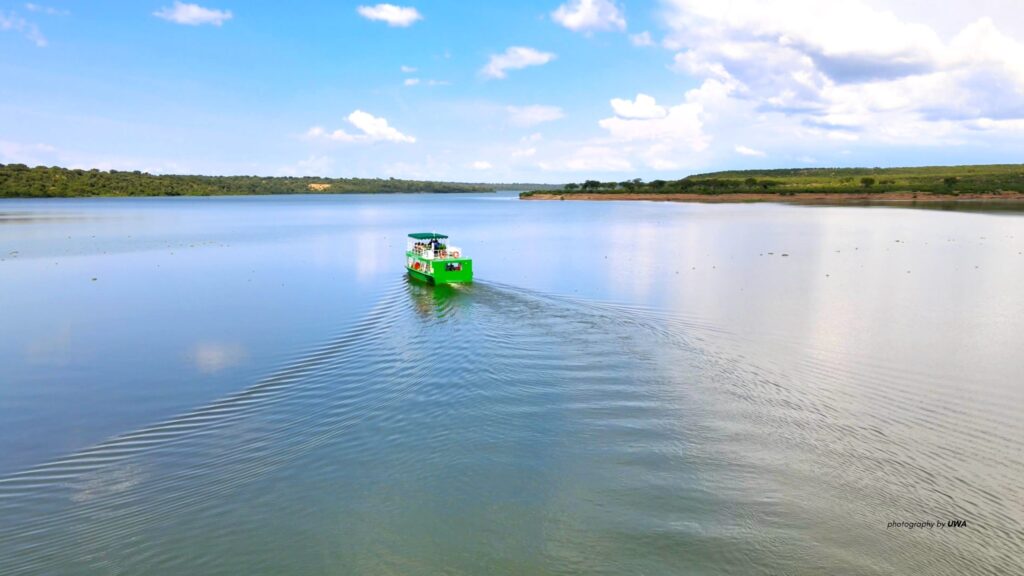
The Kazinga Channel is a natural, 32-kilometre waterway linking Lake Edward and Lake George through the heart of Queen Elizabeth National Park, and its two-hour boat cruise is widely considered the single best wildlife-viewing activity in the park, delivering closer, more reliable sightings than a game drive on the days when the savanna itself is quiet. The channel supports one of the largest concentrations of hippopotamus in Africa, with an estimated 1,600 or more individuals congregating along its banks, alongside basking Nile crocodiles, elephants, and buffalo that come to drink at the water’s edge, and a genuinely exceptional density of waterbirds.
What You’ll See on the Cruise
Boats depart from a jetty near Mweya Safari Lodge on the Mweya Peninsula in two daily sessions, typically mid-morning and mid-afternoon, and run for roughly two hours. Beyond the hippo pods, expect African fish eagles, pied kingfishers, saddle-billed storks, African skimmers, and, with luck, the prehistoric-looking shoebill stork in the channel’s papyrus fringes. Because so much of the park’s terrestrial wildlife also depends on the channel for water, particularly during the dry season, a single cruise regularly produces a wider range of species in two hours than a half-day game drive across the same period.
Booking and Timing
The cruise costs approximately USD 30 per person for foreign non-residents and can be booked directly at the jetty, through the Uganda Wildlife Authority, or, more reliably during peak season, in advance through your lodge or operator, since only a limited number of boats operate on the channel at any one time. The dry-season months concentrate the most wildlife along the banks as smaller waterholes dry up elsewhere in the park; the wetter months are quieter for game but noticeably better for migratory bird species passing through.
Beyond Big Cats: Chimpanzees, Crater Lakes, and 600 Bird Species
Queen Elizabeth National Park rewards travellers who spend more than a single game drive and a boat cruise there. Three further experiences round out a complete visit: chimpanzee trekking in a dramatic forest gorge, a scenic detour through a field of extinct volcanic crater lakes, and some of the best birding anywhere in East Africa.
Kyambura Gorge: The Valley of Apes
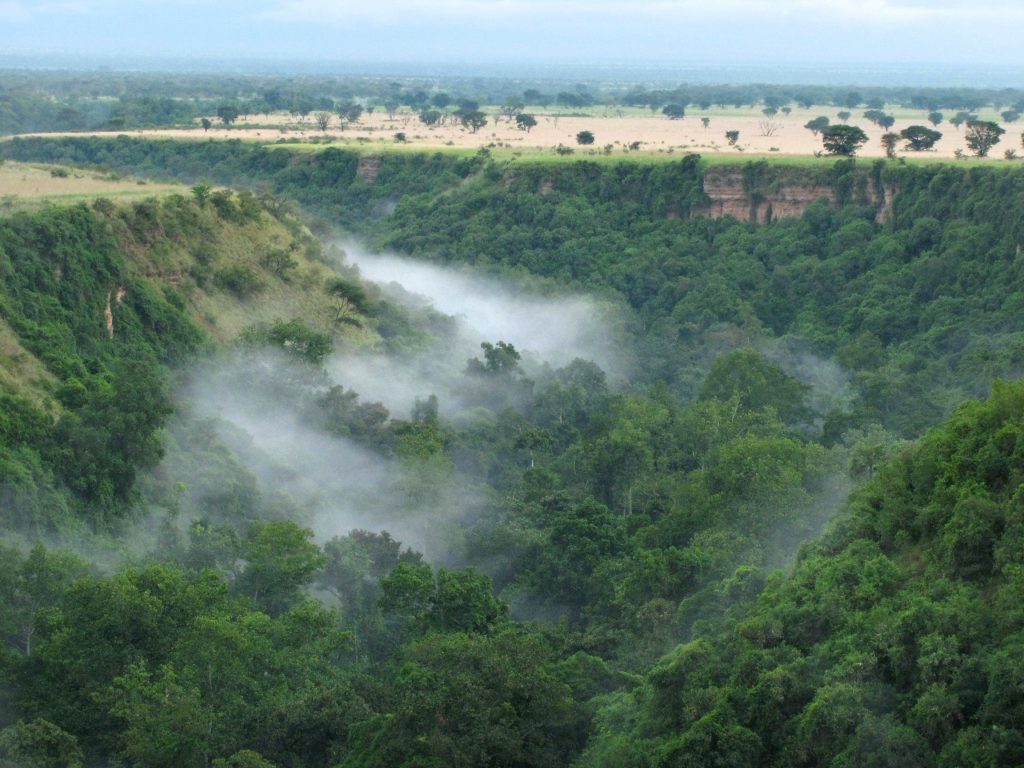
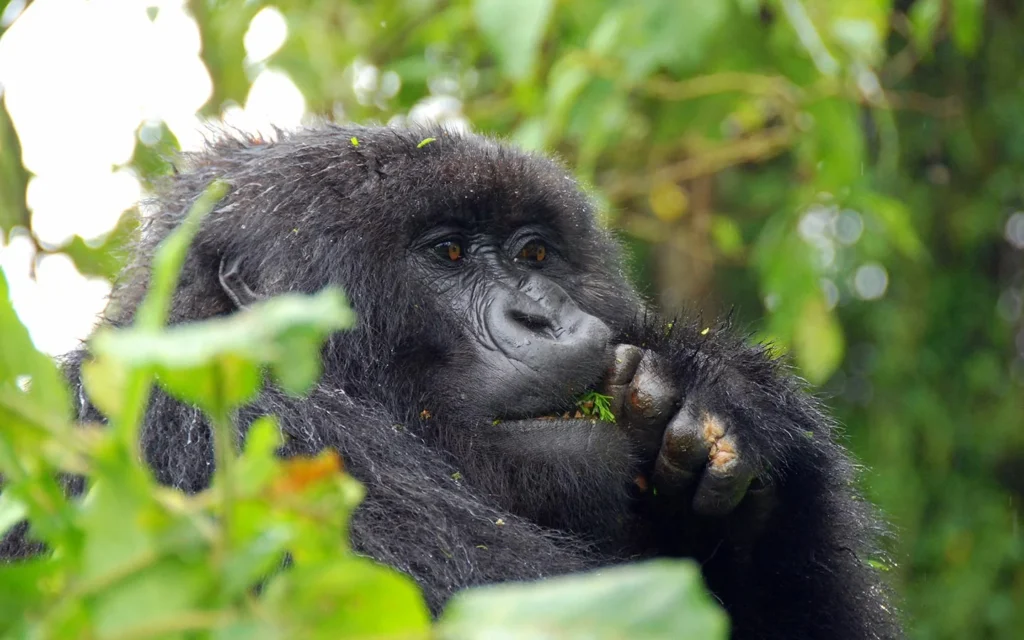
Kyambura Gorge, nicknamed the Valley of Apes, is an 11-kilometer-long forested canyon cut into the eastern savanna of Queen Elizabeth National Park, home to a habituated community of eastern chimpanzees that can be tracked on a guided forest walk. A chimpanzee permit at Kyambura costs USD 100 per person for foreign non-residents in 2026, a fraction of the USD 250 charged at Kibale Forest National Park, Uganda’s premier chimp-trekking destination, though sighting probability at Kyambura is lower given the community’s smaller size and the gorge’s more limited habituation history. Only 16 permits are issued per day across two sessions, and the gorge sits roughly 25 to 30 kilometres from the Mweya area, close enough to combine chimp trekking and a Kazinga Channel cruise inside a single two-night stay.
The Explosion Crater Lakes and Maramagambo Forest
North of the Mweya Peninsula, a chain of volcanic explosion craters, most spectacularly along the aptly named Crater Drive, offers some of the park’s most striking scenery: a scattering of small, jewel-toned lakes, several of them saline, set into a rolling volcanic landscape that looks almost nothing like the savanna a few kilometers away. Katwe Crater, the largest and best known, has been mined for salt for centuries and remains an active salt-harvesting site today. To the park’s south-east, Maramagambo Forest offers a quieter, more forested contrast, guided nature walks, a bat cave with a resident python that has made local news for preying on the cave’s bats, and excellent forest birding away from the more visited savanna sectors.
Birding: One of Africa’s Richest Lists
With more than 600 recorded species, the bird list of Queen Elizabeth National Park is among the longest of any protected area on the continent, spanning savanna raptors, papyrus swamp specialists along the Kazinga Channel, and forest species in Maramagambo. Serious birders typically build in an extra day specifically for the channel’s papyrus fringes and the Kasenyi Plains at dawn, when raptor activity and Uganda kob concentrations are both at their peak.
| Activity |
Where |
Indicative Cost (non-resident) |
Duration |
| Park entrance |
Any gate |
USD 40 / 24 hrs |
— |
| Kazinga Channel boat cruise |
Mweya Jetty |
USD 30 pp |
~2 hours |
| Kyambura Gorge chimp trekking |
Kyambura Gorge |
USD 100 pp |
Half-day |
| Lion tracking research experience |
Kasenyi / Mweya (with UCP) |
~USD 220 pp |
Half-day |
| Standard game drive |
Kasenyi or Ishasha |
Vehicle and guide fees vary by lodge. |
3–4 hours |
| Crater Drive / Katwe salt lakes |
North of Mweya |
Included with vehicle hire |
2–3 hours |
Queen Elizabeth National Park vs. Rwanda’s Akagera and Other East African Savanna Parks
Travellers weighing where to add a savanna component to a primate-focused Rwanda or Uganda itinerary usually compare Queen Elizabeth against Rwanda’s own Akagera National Park and, for those thinking bigger, against Kenya’s Masai Mara or Tanzania’s Serengeti. Each answers a slightly different brief, and the honest comparison matters more than a simple ‘which is better’ verdict.
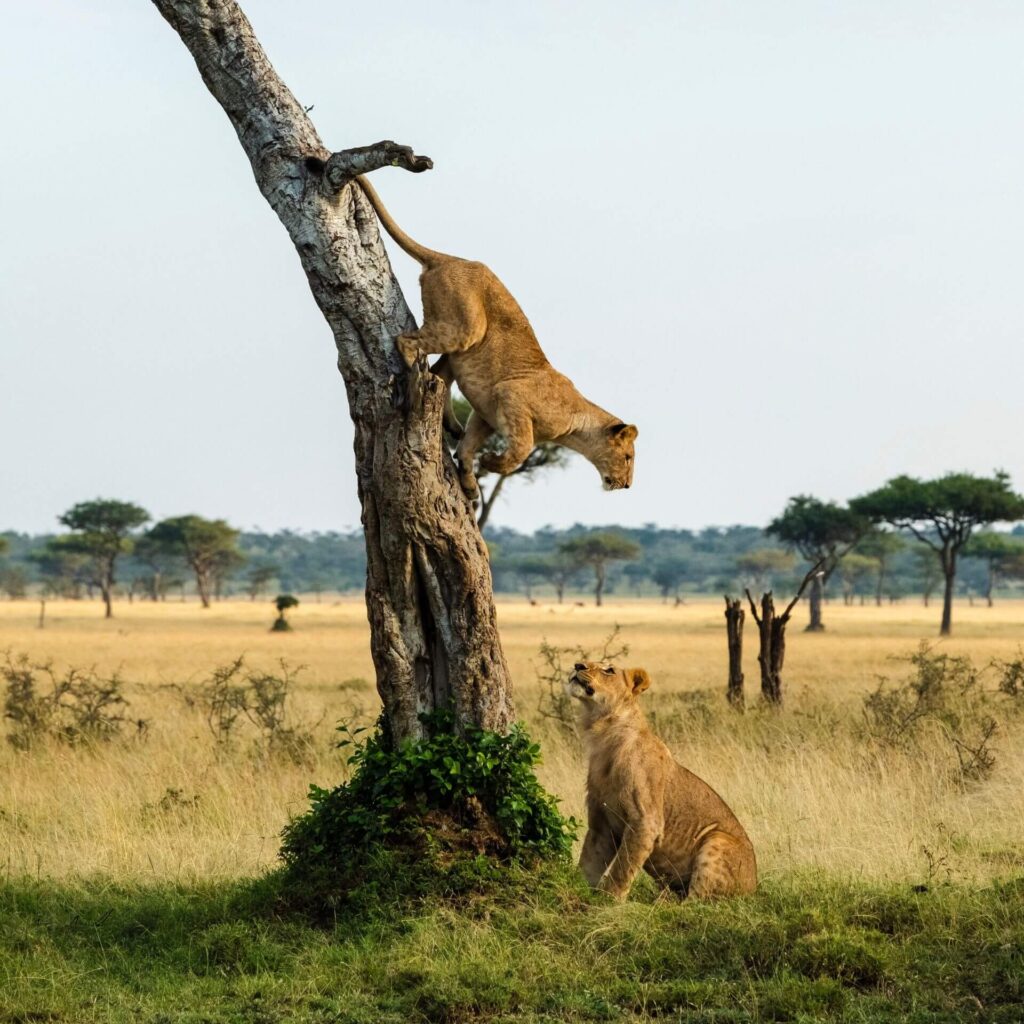
Akagera has the edge for travellers who want a genuine Big Five park: lion, leopard, elephant, buffalo, and both black and white rhino, all inside the same country as a Rwanda gorilla trek, with no border crossing at all. Queen Elizabeth does not currently hold rhino, but it offers something Akagera cannot: the specific, named spectacle of tree-climbing lions, a considerably larger and more varied bird list, and the option to add chimpanzee trekking on the same itinerary without a further flight. For travellers who have already committed to Uganda gorilla trekking in Bwindi, Queen Elizabeth is simply the more efficient, closer savanna add-on; for travellers anchored in Rwanda who want to stay inside one country, Akagera remains the simpler routing.
| Park |
Country |
Size |
Signature Wildlife |
Pairs With Gorilla Trekking? |
| Queen Elizabeth NP |
Uganda |
1,978 km² |
Tree-climbing lions, Kazinga Channel, chimpanzees |
Yes, via Bwindi (Ishasha) or the Rwanda–Uganda circuit |
| Akagera NP |
Rwanda |
1,122 km² |
Full Big Five (incl. rhino), shoebill stork, low crowds |
Yes, same country, no border crossing |
| Masai Mara |
Kenya |
~1,510 km² |
Big Five, wildebeest migration (Jul–Oct) |
No, separate country and flight sector |
| Serengeti |
Tanzania |
~14,750 km² |
Great Migration, Big Five, sheer scale |
No, separate country and flight sector |
How to Get to Queen Elizabeth National Park: Road, Air, and the Bwindi Connection
Queen Elizabeth National Park is reachable by road from Kampala, by scheduled light-aircraft flight from Entebbe, and, for most travellers researching this park in the first place, by a short road transfer from Bwindi Impenetrable Forest after a gorilla trek.
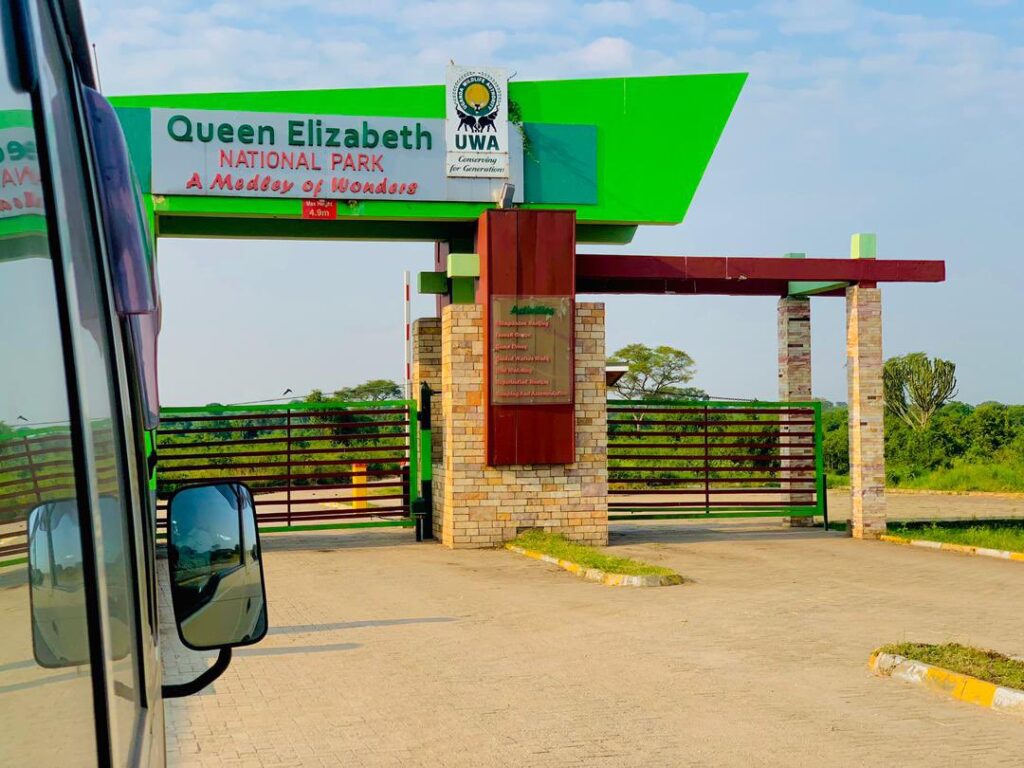
By Road from Kampala or Entebbe
The direct road distance from Kampala to Queen Elizabeth National Park is approximately 410 kilometers, a drive of six to eight hours depending on the route and traffic through Mbarara or via Fort Portal, and most itineraries break this journey with a stop at another park or the equator crossing at Kayabwe rather than attempting it in a single push.
By Air: Kasese and Mweya Airstrips
Scheduled flights operated by AeroLink Uganda connect Entebbe International Airport to the Kasese and Mweya airstrips inside or immediately adjacent to the park, with a flight time of roughly one hour and fifteen minutes compared to a six-to-eight-hour road transfer. Three daily rotations typically operate in each direction, and inter-park charters can also connect Queen Elizabeth directly with Bwindi’s Kihihi airstrip or Murchison Falls without routing back through Entebbe, which is worth arranging in advance for time-constrained luxury travellers.
The Bwindi-to-Queen Elizabeth Route via Ishasha
For the large majority of international travellers researching gorilla trekking, the relevant question concerns the drive from Bwindi rather than the drive from Kampala. From Bwindi’s Buhoma sector, the road to the Ishasha sector of Queen Elizabeth National Park covers approximately 64 kilometers and takes two to three hours, making it entirely realistic to trek gorillas in the morning and be inside Queen Elizabeth, watching for tree-climbing lions, by the following afternoon. From Bwindi’s southern sectors, Rushaga or Nkuringo, the same connection takes five to seven hours via Kabale and Kisoro, a materially longer transfer that shapes which Bwindi sector is worth choosing if a Queen Elizabeth extension is already part of the plan.
Crossing from Rwanda via Cyanika
Travellers whose gorilla trek takes place in Rwanda’s Volcanoes National Park rather than in Uganda can still reach Queen Elizabeth as part of a wider circuit, crossing overland at the Cyanika border post near Kisoro, roughly 40 minutes from Volcanoes National Park, before continuing north through Bwindi’s southern sectors to Ishasha. This is the routing behind most of the ten-to-fourteen-day Rwanda–Uganda combination itineraries our team designs, and it is covered in more operational detail in our Rwanda vs Uganda gorilla trekking comparison.