The Mountain Gorilla: Biology, Family Life, and Conservation Status
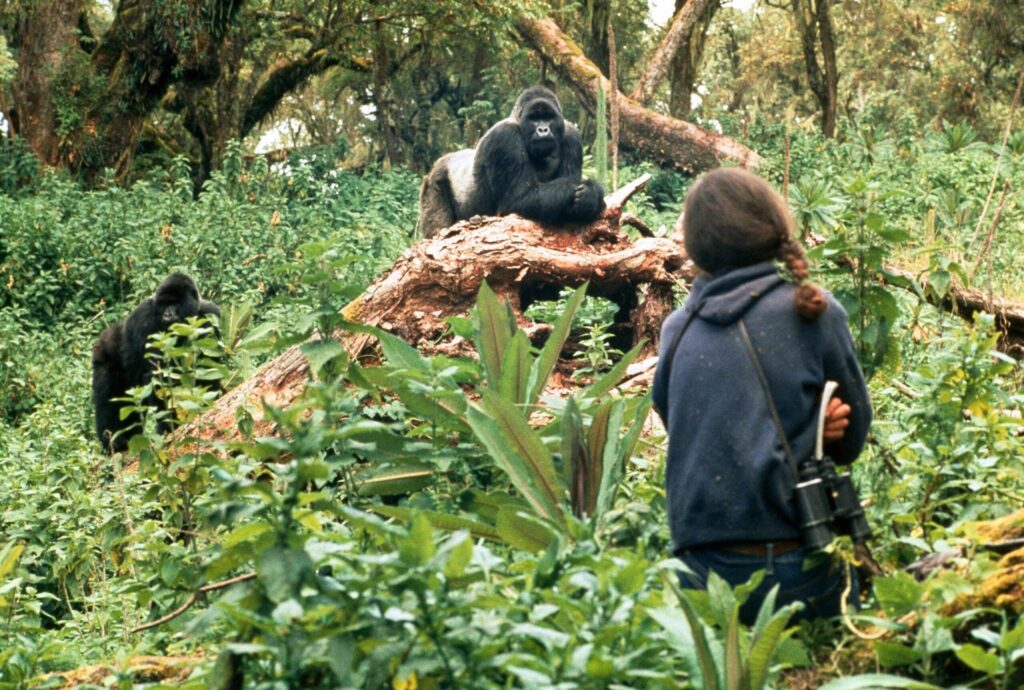
The mountain gorilla is the larger of the two eastern gorilla subspecies, with adult males, known as silverbacks, once they mature past roughly twelve years of age, reaching up to 220 kilograms and standing nearly two meters tall when fully upright. Despite that physical scale, mountain gorillas are almost entirely herbivorous, feeding on leaves, stems, shoots, bark, and occasional fruit, with an adult silverback capable of consuming over 30 kilograms of vegetation in a single day. They rarely drink standing water, deriving most of their moisture from the plants they eat and the morning dew that collects on montane forest vegetation.
Gorilla families are organized around a dominant silverback, whose role extends well beyond reproduction into arbitration, protection, and the day-to-day decision-making that determines where the family forages, rests, and nests each night. Beneath him, a hierarchy of blackbacks, subordinate silverbacks, adult females, juveniles, and infants forms a genuinely complex social structure, one in which relationships are continuously negotiated through posture, vocalization, and physical proximity rather than open conflict. Infants remain dependent on their mothers for up to three years, and the bonds formed in that early period persist across a gorilla’s full lifespan, which can extend past 40 years in the wild.
Mountain gorillas cannot survive in captivity. Every attempt to maintain the subspecies outside its native high-altitude forest habitat, generally between 1,500 and 4,000 meters above sea level, has failed, which means every mountain gorilla alive today exists in the wild, and every trekking encounter takes place entirely on the animal’s own terms, in its own habitat. As recently as 1981, the global mountain gorilla population had fallen to an estimated 254 individuals, a number low enough that extinction within a generation was a realistic near-term outcome rather than a distant hypothetical. Sustained conservation investment, funded overwhelmingly by trekking tourism revenue, has since driven that number past 1,000, making the mountain gorilla the only great ape subspecies on earth with a population trend currently moving upward rather than down. Roughly half of that population lives in the Virunga Massif shared by Rwanda, Uganda, and the DRC; the other half lives in Uganda’s Bwindi Impenetrable Forest.
A Gorilla Trekking Day From Start to Finish
The rhythms of a trekking day vary in detail across the three countries, but the underlying structure is remarkably consistent, and understanding it in advance removes most of the anxiety that first-time trekkers carry into the experience.
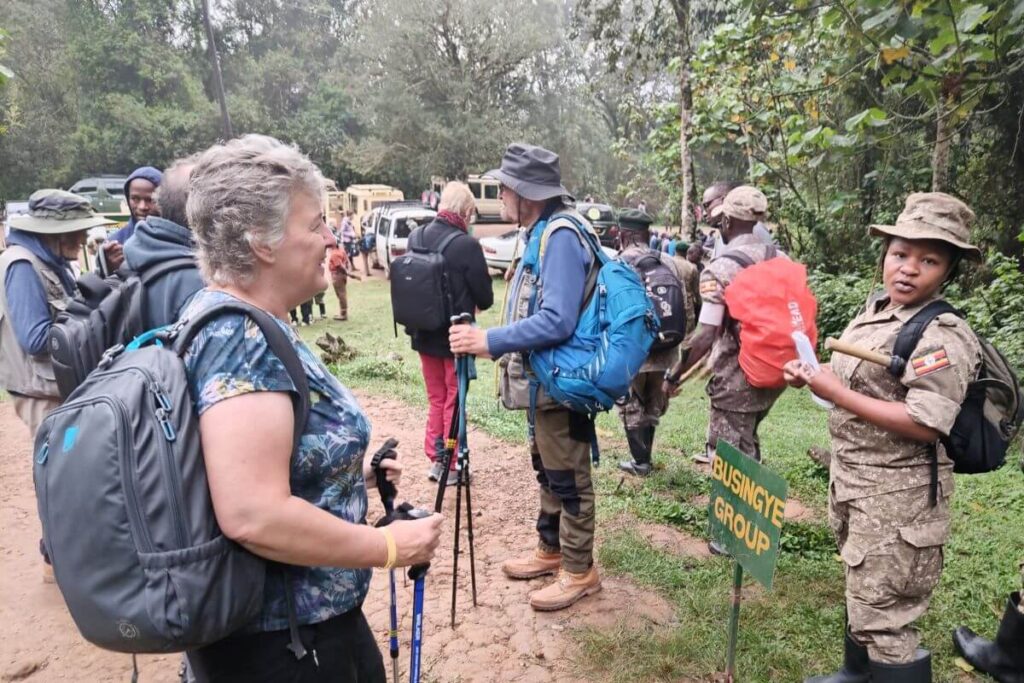
The day begins early, typically with breakfast before or around six in the morning, followed by a transfer to the park’s briefing center Kinigi in Rwanda, one of Bwindi’s four sector headquarters in Uganda, or the equivalent ranger post in the DRC. The morning briefing, usually starting around seven o’clock, is where rangers assign each group of up to eight visitors to a specific gorilla family, generally based on the family’s most recent known location, reported by scouts who left before dawn to relocate the family from the previous night’s nesting site, and the group’s stated fitness level. This stage is also the point at which most parks offer porters for hire, local community members who carry day packs and provide practical assistance on difficult terrain; hiring one is inexpensive, meaningfully supports a local livelihood, and is recommended for essentially every trekker regardless of fitness.
From the briefing center, groups transfer by vehicle to the trailhead closest to their assigned family’s location before setting off on foot, led by an armed ranger guide and accompanied by trackers already in the field. The walk itself is the genuinely variable part of the day: some families are reached within thirty to sixty minutes of easy walking; others require three to five hours of steep, muddy, physically demanding hiking through dense vegetation. No operator, in any of the three countries, can guarantee trek duration in advance, because gorillas move continuously overnight in search of food, and their location on any given morning is a fact discovered fresh each day, not scheduled in advance.
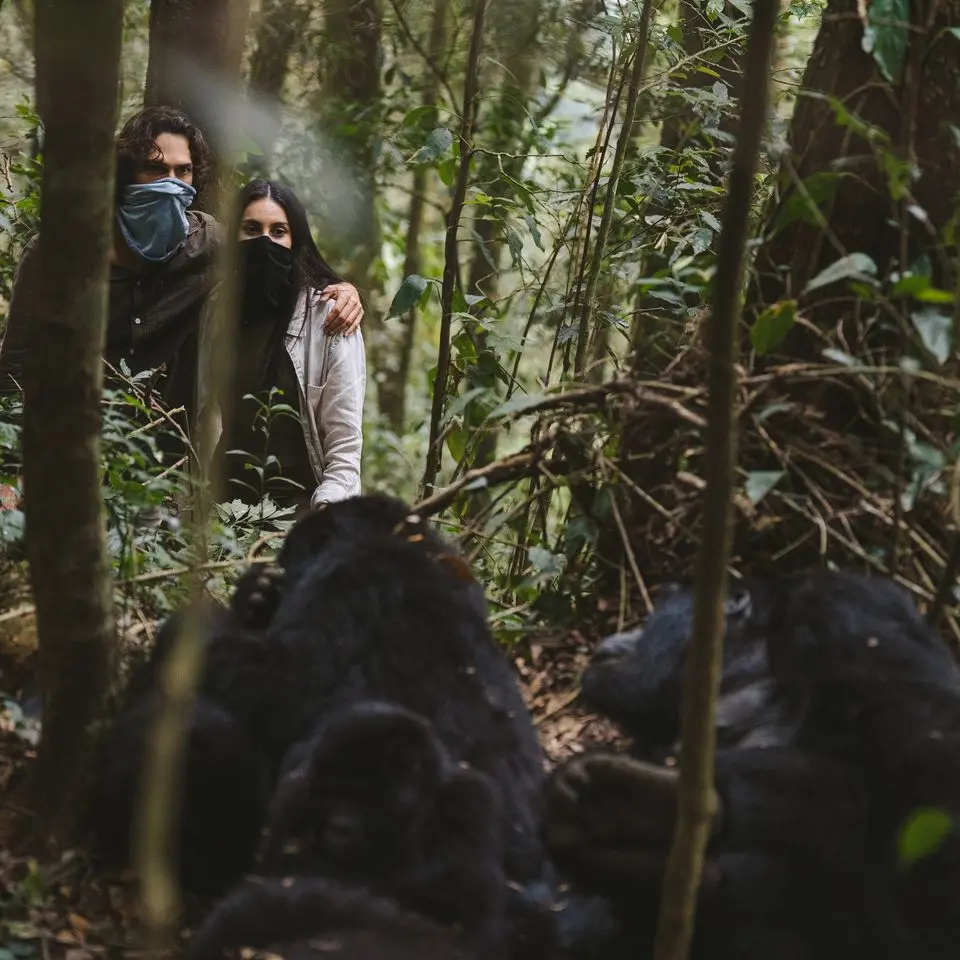
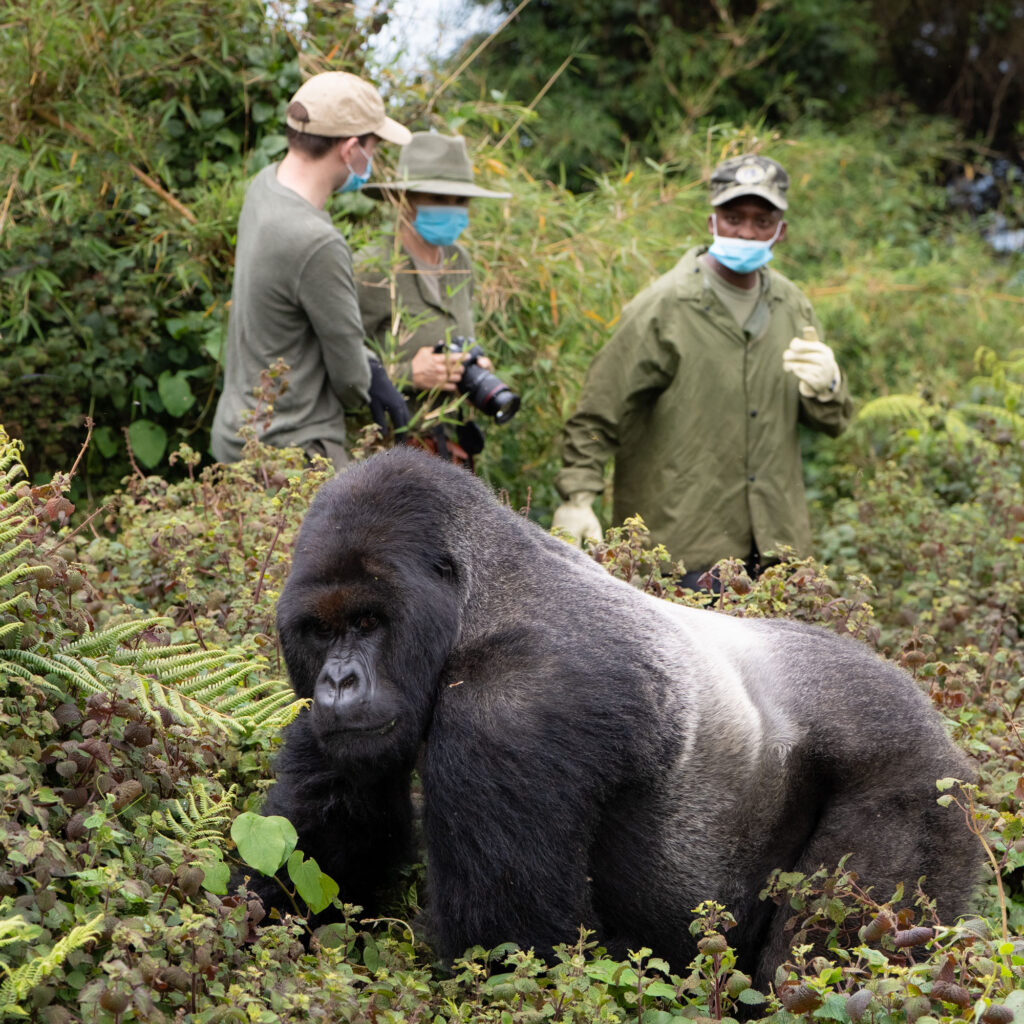
When trackers make contact, the atmosphere shifts abruptly. Voices drop to a whisper, cameras are lowered, and the guide leads the group forward at a slow, deliberate pace until the forest simply, without ceremony, contains gorillas. The one-hour observation clock starts once the group has settled at the mandated minimum distance, though gorillas themselves frequently close that gap on their initiative, walking directly past or through a trekking group with an indifference that most visitors find as startling as the encounter itself. Flash photography is prohibited throughout; ordinary photography and video are permitted and encouraged. After the hour concludes, the group withdraws quietly, retraces its route to the trailhead, and returns to the briefing center, where a certificate is issued a small but genuinely meaningful formality that marks the close of the experience. Most trekking days conclude by early to mid-afternoon, leaving the remainder of the day free for lodge relaxation, a cultural visit, or an additional activity such as golden monkey trekking.
Trekking Difficulty, Fitness, and Age Requirements
Gorilla trekking spans a genuinely wide range of physical demand, and the honest answer to “how hard is it” is: it depends entirely on where your assigned family happens to be on the morning of your trek. At the easier end, some families range in lower-elevation, more accessible terrain, reachable within an hour of gentle walking on established paths, and manageable for reasonably fit travelers of almost any age. At the more demanding end, families that have moved into steep, high-altitude, densely vegetated terrain can require three to five hours of strenuous hiking over uneven, often muddy ground at elevations above 2,500 meters. Because gorillas relocate nightly and the park authority and operators cannot predict exactly where a given family will be found, no one can promise a short trek; your guide will, eventually, bring you to the gorillas, whatever the day requires.
That said, there are ways to meaningfully manage this variability. Rangers do their best to match groups to families based on reported fitness levels at the morning briefing, and travelers with genuine mobility concerns should communicate their needs honestly and in advance, not on the morning of the trek. Hiring a porter, available in every trekking destination for a modest fee, materially reduces physical strain by carrying your day pack and offering a steadying hand on difficult sections. A walking stick, typically available for hire at the briefing center, and well broken-in, waterproof, ankle-supporting boots make a disproportionate difference to comfort over the course of a multi-hour hike. For travelers who want to remove the variability altogether, Rwanda’s exclusive gorilla trekking option, discussed in detail in the exclusive gorilla trekking guide, allows a degree of family selection and pacing control that standard shared permits do not.
Age requirements are strict and uniform across all three countries: the minimum age for standard gorilla trekking is fifteen years, with no exceptions made regardless of a younger traveler’s fitness or a parent’s preference. The rule exists primarily to protect gorillas from childhood illnesses to which they may be especially vulnerable and secondarily reflects the genuine physical and behavioral demands of the trekking environment. Families traveling with children under fifteen are not excluded from a broader safari; golden monkey trekking, cultural village visits, and savannah game drives in parks such as Akagera National Park carry no comparable age restriction and can anchor a family itinerary around the adults’ gorilla trek.
What to Wear and Pack for Gorilla Trekking
Dressing correctly for a gorilla trek is a matter of function rather than fashion, and the difference between the right kit and the wrong kit is the difference between a genuinely comfortable morning in the forest and an avoidable ordeal. The governing principle is layering: temperatures at altitude in the Virunga foothills or Bwindi’s high sectors can swing from cool at dawn to warm by mid-morning, and forest weather can shift from bright sun to sudden rain within the span of a single trek.
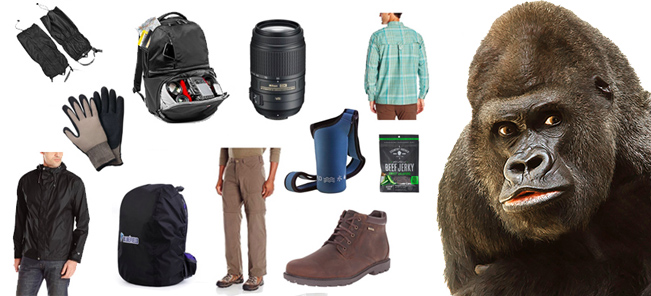
Long-sleeved shirts and long trousers in muted, dark tones: olive, khaki, deep green, or grey, are the correct choice; bright colors and white clothing are both discouraged, the former for potentially disturbing the gorillas, the latter for showing dirt and attracting insects. A lightweight, packable waterproof outer layer is close to essential, since forest rain at these elevations arrives with little warning. Gardening or lightweight work gloves prove genuinely useful for pushing through dense vegetation, and a hat offers protection from both sun and intermittent rain.
Footwear is the single most consequential decision. Waterproof, ankle-supporting trekking boots with a firm, aggressive sole are non-negotiable; the forest floor is reliably uneven and frequently wet, and trainers, sandals, or any flat-soled shoe will make the experience measurably harder than it needs to be. Gaiters, worn from boot to lower calf, keep out both moisture and the stinging nettles that grow in abundance throughout gorilla habitat and are available for hire at most briefing centers for travelers who don’t own a pair.
For the day pack itself, plan for at least two liters of water, a packed lunch or snacks, a basic first aid kit, insect repellent, sunscreen, and a camera or phone in a protective case, ideally paired with a telephoto or rapid prime lens for the dappled, fast-changing light conditions typical of montane forest. Extra batteries and memory cards are worth the marginal weight; the hour passes quickly, and running out of storage mid-encounter is a genuinely common regret among first-time trekkers.
The Best Time of Year for Gorilla Trekking
Gorilla trekking is possible year-round across all three countries, a meaningful advantage over destinations where seasonal access windows eliminate large stretches of the calendar from consideration. That said, seasonal variation still shapes both the physical experience and the logistics of booking.

Two dry seasons define the region’s most popular trekking periods: the long dry season, roughly June through September, and the shorter dry season, December through February. Trails are firmer and less muddy in both windows, and the reduced likelihood of heavy rain generally makes for an easier physical experience, particularly on the more demanding trekking routes. These are also, unsurprisingly, the periods of highest demand and tightest permit availability across Rwanda, Uganda, and the DRC alike, meaning bookings for travel in either window should be locked in six to twelve months ahead wherever possible.
The two rainy seasons, the long rains from roughly March through May and the short rains in October and November, bring a different set of trade-offs. Trails become muddier, and the physical demands of a trek increase correspondingly, but permit prices in Rwanda hold steady year-round regardless of season, visitor numbers in the parks drop meaningfully, and the forest itself turns a deeper, more vivid green that many experienced trekkers and photographers actively prefer. Uganda offers a genuine financial incentive during its wettest months, with permit prices dropping to USD 600 during April, May, and November on fixed, non-reschedulable dates. For travelers with flexible dates and a tolerance for wet-weather trekking gear, the rainy seasons offer a materially different, more solitary version of the same encounter at a lower cost and with less competition for permits.